5.04.2012

Dog Day Afternoons...and Mornings

There have been so many things I've wanted to blog about lately - food, work, life and my latest explorations through the local countryside. With nearly a week past since my last blog, I realize I have been remiss in my updates. So, for my peace of mind and (hopefully) your reading pleasure, I plan to spend the next couple of days writing about all of the things I've been storing in my mental journal for the past week. Prepare for the blog blitzkrieg!

Sabrina enjoys a sunny afternoon in the backyard.

I am a very lucky girl, with a very lucky dog. Every morning I wake up - at the behest of my canine - around 6:30. After stumbling down the stairs and going outside with Sabrina, we both make our way back upstairs for our morning dance around the kitchen. As I pour the kibble into the waiting doggie bowl by the door, Sabrina patiently waits for my command to have at it. While she eagerly - and by eagerly I really mean voraciously - consumes the cup of food, I make my cup of coffee. After she's done eating we make our way to the living room, and while I'm sipping my cup of joe we watch a bit of news. Sabrina likes the Today Show, so I oblige her by flipping to NBC. After an hour of news, it's time for our daily walk - usually 30-45 minutes in the local park. On Mondays and Tuesdays, Sabrina enjoys the hours after our walk by pacing after me around the house as I clean up. On Wednesdays and Thursdays she's left to her own devices as I leave her and make my way up to Crocker to work at the animal shelter. On Friday mornings she usually looks at me with wonderment while I write a witty blog about our latest adventure, and then somehow cons me into taking her for another walk - partly because I feel guilty she's been laying around all morning/partly because she's got the most pathetic puppy face. All of our afternoons are spent either: running errands, taking cooking classes, exploring the wilds of Missouri, playing the piano, attempting to make a pillow with my new sewing machine, watering flowers, doing yoga, and/or prepping for dinner. Our evenings and weekends are spent as a family, usually doing yard work, lazing around the house, or taking hikes on nearby trails. It's a wonderful life I'm leading right now, and it's a wonderful new life for Sabrina....but that wasn't always the case for our sweet little dog.

Three months ago I started working at Loving Paws Adoption Center. I've always had a special place in my heart for animals. I had two dogs growing up: Hatler - a Bassett Hound, in my Elementary School Years, and Hoosier - a Yellow Lab, in my Middle School and High School Years. Both were purebreds, both were puppies, and both had little life experience away from the mothers. Still, while I cared about animals, until I began working at the shelter I didn't realize how much I could love and care about animals, and how cruel and heartless so many people are to thousands of cats and dogs who just want to be part of a family (pack).

I've seen nearly 60 dogs and cats come in and out of the shelter in Crocker since my start in February. Every now and then a couple of puppies or kittens will find their way to our facility. However, most of the dogs and cats that we take in are 2 years or older; dogs that have been left behind by transitioning families, dogs rescued from puppy mills and crack houses, dogs and cats that were once puppies and kittens, but who lost their appeal or were never trained by their families and just became a nuisance to their owners. While some were abused physically, almost all were abused emotionally. Every now and then we'll get a family who uses our services because they have received orders to go to Hawaii and don't want to put their animals in quarantine for 4 months, and they just want to find a good home for their pets - I wish this happened more often than it does. Currently we have ten dogs, 3 cats, 1 puppy and 2 kittens at the shelter, all of them rescues.

Yesterday, I experienced a first at the shelter. As I was coming in from cleaning the outside runs, an older gentleman in a Club Car Golf Cart, with what I assumed was his toddler granddaughter seated next to him, pulled up. I smiled at him, waved at the little girl, and asked if I could help him with anything. The following conversation ensued:

Him: "You all have any bunnies?"
Me: "No, we don't."
Him: "None?"
Me: "We're a shelter that only takes in cats and dogs, but let me ask Dawn - the manager - if any of the other shelters in the county have any."
**I open the front door and stick my head in and ask if any of the other shelters have rabbits. The answer is no, but she gives me the name of a local farm that may have some.**
Me: "Sir, none of the other shelters have bunnies, but she says you may want to check Eircels."
Him: "Hmm, alright. Yeah, I was hoping you may have some. I have four at home that I came across the other day. One's a nice big buck, probably about 7 or 8 pounds. He'd probably make good for mating."
Me: "Hmmm."
Him: "Yeah. I was looking round to see if anybody mighta wanted 'em, but then I started thinking about how the buck would be good to keep. So, for now looks like the others will be getting stocked in my freezer. I'll be eating good this week. Still, hoping I can maybe find some more."
Me: "Well sir, sorry, but not here. Have a nice day."
Him: "Mmrrmmph...you too."
**I then turned and went into the shelter."
Me: "Dawn, I thought that man had brought his grand-daughter here to look for a pet bunny-rabbit. He was just looking to shop for food at an animal shelter! Ugh."
Dawn: **shakes her head** - "These people..."

Unfortunately, "these people" are all over "these parts." They are the kind of people that leave their dogs tied to trees and never feed them, or leave them to just run as they will without any vaccinations. Loving Paws takes in as many as we can. It is a no-kill shelter, sponsored by the Pulaski County Humane Society, funded solely by donations, and run by an all-volunteer staff. All cats and dogs that come to the shelter receive necessary vaccinations and are spayed or neutered. We try to give them a bit of a home, until they can find their forever families. Some of them stay longer than others. Sabrina, for example, had been at the shelter for 6 months, living in a 4x12 indoor/outdoor run; that's no life for a dog. And yet, for some of them, it's a better life than what they had. 

Sabrina had been in a home for a couple of months prior to her stay at Loving Paws, but when the family she had previously lived with decided to get a pit bull who didn't care too much for Sabrina, they decided to get rid of her. Prior to her two month household stint she had been in the Waynesville shelter, prior to that a stray, and prior to that we don't know. It's been a long couple of years for our pup, but she's finally in a good place.

Despite the sad state in which I see some of the animals come to our shelter, I love what I'm doing, and there are many days I come home to tell Matt about the sweetest dog that is weedling its way into my heart - much the same way Sabrina did. But, more often than not, the pooch that I start falling for gets adopted within a few weeks and finds his or her perfect family.

In addition to my typical shelter duties, I have become the resident photographer for the adoption center. When we get a new dog/cat in, and once they have been with us for at least a week (enough time to get them vaccinated and groomed), we take them out for their "official photo shoot." I take a series of pictures, come home and edit them, and then send them to the Vice President of the Humane Society, who loads them onto PetFinder and the Loving Paws website. It's quickly become one of my favorite pastimes. 

So, in honor of the cats and dogs that I get to help take care of every week, I thought I'd share some of my favorites with all of you.

Pluto came to us as a stray with a collar, but no tags or microchip to identify him. After being with us for two weeks, we received a phone call from his family who saw his photo on PetFinder. Apparently the big lug had been let outside and broken his tether. The family had been looking for him and were so happy when they found his picture. This was a happy reunion.

Misty was a stray found along a local county road. She stayed with us for three weeks and then was adopted by a nice, older woman.

Sammy has become the "shelter cat." He's been at the facility since I've been there. He's a sweet guy, but nobody seems to want him because he's too old.

Trixie came to us as a two month old puppy. She quickly got adopted.

If I could have brought home another dog, it would have been Socks. Socks lived at the shelter for nearly two months. He came to the facility with his mother (Poochie) and brother (Chip), who were found tied to a tree and left to fend for themselves. He finally got adopted by a great family who had a young son that just wanted to run and play with him, which was great because the Border Collie in Socks wanted to play ALL THE TIME!

Our resident "old guy," Pedro came to us as a stray who was hurting from arthritis in his 9 year old bones. He was at the shelter for nearly three months when we received a phone call from a lady saying she was looking online at photos on PetFinder and Pedro looked an awful lot like her next door neighbors lost dog. As the family who had previously owned Pedro didn't have the internet, she told them she thought he was at Loving Paws. There was a happy reunion with the dog and his family in early April. Despite the arthritis, the old man somehow found it in his legs to jump straight into the arms of his lost parents.

Dodger is a Rottweiler mix who has been at the shelter for the past month. He is an extremely laid back guy, despite his hulking exterior and serious looking face. The vet believes Dodger is 5 years old. He has only 4 teeth partially remaining in his mouth. All of his other teeth have been worn down from excessive chewing and grinding - probably from being tied up for a long period of time and trying to gnaw through a chain.

Checkers is our resident hound-dog. He was picked up by the Crocker P.D. last week, running wild in the countryside. He had no collar and no manners when he came to the shelter, which makes us think if he's ever been anybody's, he's never been inside a home. However, he's quickly learning that there are perks to having human companions - food twice a day, a warm place to stay at night, a comfy blanket (changed daily), treats and toys, and of course lots of love and affection. Still, Checkers' primary M.O. is to take people for a walk, not have people take him for a walk. This guy is a pureblood Blue Tick Coonhound so his nose is usually always on the ground and in hot pursuit of whatever it is he smells!

Kip has only been at the shelter for a few days, and he's REALLY in need of his appointment at Pampered Paws - his hair is a hot mess! However, I couldn't resist taking a picture of the little guy yesterday because he's just so darn grungy and cute. We think he's a Shih Tzu or a Lhasa Apso....were not too sure...but whatever he is I truly believe he could pull off being a Jerry Garcia look-alike in a Grateful Dead tribute band.

These are just a few of the cute critters I get to work with twice weekly. If I tried to put all of their pictures on this blog it would undoubtedly take way too long to load and twice as long for me to write. In the coming months, however, I plan on keeping you all updated about some of my latest charges, and let you know if those still at the shelter get adopted. For those that have been adopted, I am grateful that they have found their forever homes, and for those that are still at the shelter, I hope we can help them feel loved again and ready to be part of the families which they so desperately deserve.

 Contentment...


4.27.2012

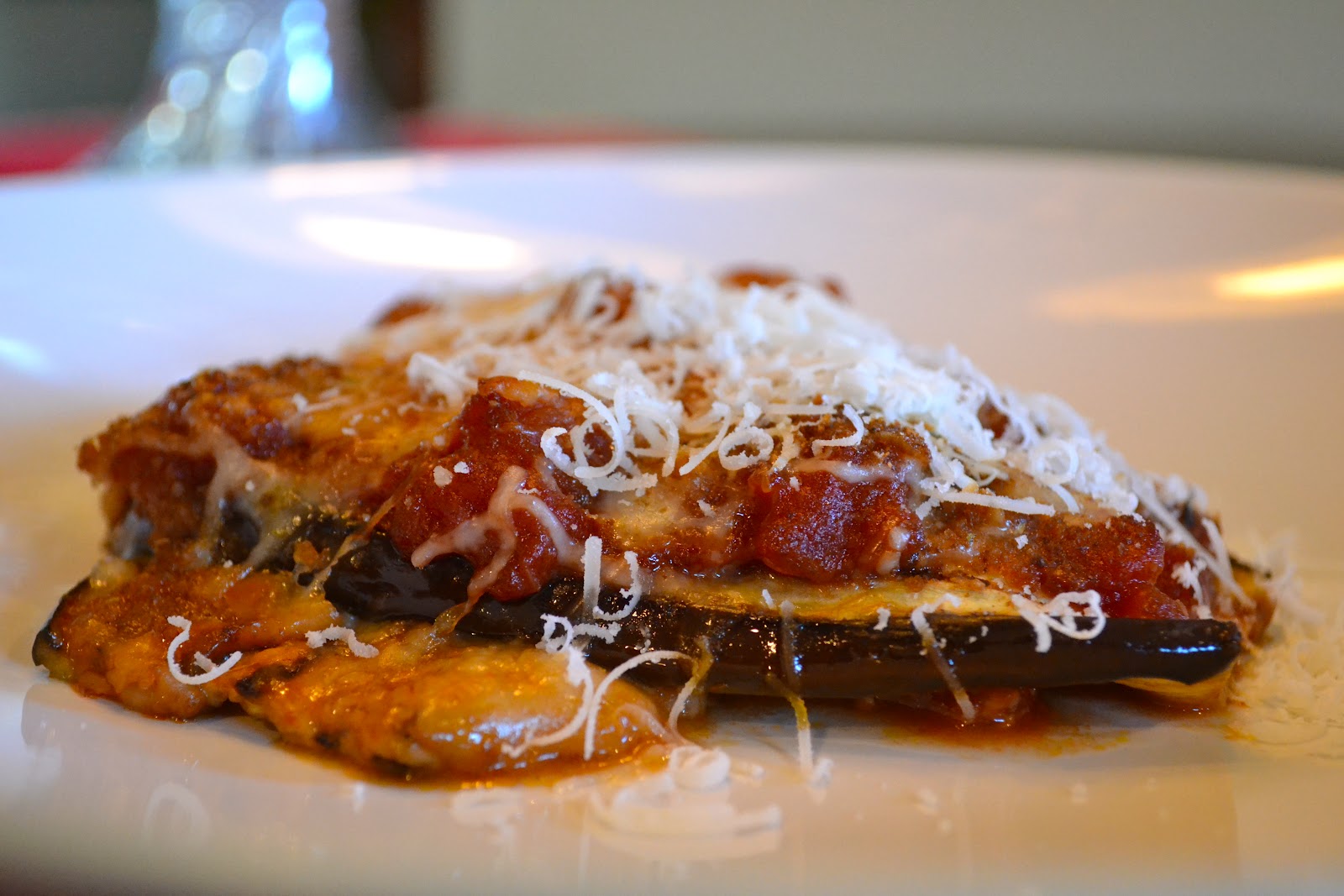
For Love of the Food - Grilled Eggplant Parmesan


Parmigiana di Melanzane alla Griglia


I love good, Italian comfort food. Whether it's pasta, chicken, fish or meat, the Italians know how to do it right: lots of flavor through a combination of herbs and spices, fresh ingredients, and finesse - because any good meal deserves the correct amount of time and love to make it perfect. Luckily, I have a lot of time on my hands.

This week - on my journeys through the aisles at the local Price Cutter - I noticed that the eggplant in the produce department looked particularly nice. With the concept to make a healthier version of eggplant parm on my mind, I grabbed two of the aubergine bulbs and added them to my cart.

Now, one thing that most people don't know is that the eggplant is actually a fruit. In fact, it's actually a berry; a rather large berry, but a berry nonetheless. As a member of the nightshade family - which includes a variety of highly toxic plants - the eggplant was, at one time, considered to be incredibly poisonous. This could be partly due to the highly bitter taste of the fruit if it is not properly salted and let sit to drain for a period of time. Also, while most people associate the eggplant with mediterranean cooking: Eggplant Parmesan (Italy), Ratatouille (France), Moussaka (Greece) and Baba Ghanoush (Turkey), the fruit is actually native to the Indian sub-continent, where it is referred to as brinjal - "King of Fruits." 

While I could sit and regale you with other interesting tidbits about the eggplant, I figure if you really want to know more you can check out the websites I've listed below in the reference section. Otherwise, let's get back to the task at hand, making eggplant parm healthy!

In the following recipe, instead of battering and frying the eggplant in flour, eggs and breadcrumbs, I have grilled the raw slices on an indoor grill pan, allowing the eggplant to retain its firmness, but giving it a seared flavor that is really warm and hearty when combined with the sauce and cheese. 

Ingredients:
2 large eggplants, comparable in size
1 28oz can of crushed or chefs cut Italian tomatoes (like San Marzano or Cento)
1 14oz can of diced tomatoes with herbs
2 tbsp fresh basil, leaves only
2 cloves garlic, sliced thin
3 anchovy filets
2 cups mozzarella cheese, grated
1 cup parmesan cheese, grated
1 cup red wine (a few glugs from the bottle)
2 tbsp EVOO, plus extra for the grill
1/2 cup breadcrumbs (optional)
salt and pepper

Directions:
Prep your eggplant by cleaning and cutting the fruit lengthwise into 1/2 inch slices (discarding the end pieces). Place in a colander lined with paper towels and liberally salt the eggplant. Let sit for 30 minutes.


Pre-heat your oven to 400 degrees.

While the eggplant is draining, start your marinara. In a large pot over medium-high heat drizzle the EVOO on the bottom of the pan and add the three anchovy filets. As the oil begins to warm, the anchovies will begin to break down and dissolve, emitting a pleasant almost nutty smell. Once the filets dissolve, add the garlic to the pot, and let simmer for just a minute. Then add the 2 cans of tomatoes, the wine, a liberal splash of salt and a couple twists of the pepper mill. Stir the pot, bring to a boil, then cover and reduce to a simmer. Be sure to stir the sauce periodically and test for taste. Add more salt, if needed.


Begin heating up your indoor or outdoor grill, spraying or brushing with a thin layer of olive oil. Over medium heat, begin adding the slices of eggplant. Sear for for 2-3 minutes (or until the eggplant is lightly softened and the char marks are nicely set). Before flipping over, mist or brush the un-seared side with EVOO. Flip and sear on opposite side for 2-3 minutes. Repeat process until all of the eggplant is grilled. Return the eggplant to the towel lined colander to absorb any excess oil. 


After all the slices are grilled, remove the lid from the sauce pot and add the basil. Stir to combine and turn off heat. 


Spray a large baking dish with EVOO, then spoon a thin layer of the marinara on the bottom. Add your first layer of eggplant. Sprinkle each slice with a some of the mozzarella, then add a spoonful of the tomato sauce to the top. 


Repeat until all the eggplant is layered - using a criss/cross method. On the final layer, sprinkle the parmesan on top of the sauce. 


(Optional) - To add a bit of a crunch - and to replicate that traditional flavor - toast 1/2 cup of Italian style breadcrumbs in a small pan over medium heat and dust the top of the baking dish.


Bake in 400 degree oven for 20-25 minutes, or until top is golden brown. Serve stacks, sprinkled with extra parmesan cheese if desired, with a glass of cabernet. Follow with and a mixed salad - after you've eaten at least two servings! 


References:

4.20.2012

A Roll of the Dice

Bridges are an aspect of engineering that have always fascinated me. From their earliest, natural beginnings (a felled tree laying over a ravine or stones creating steps in a river), they united people, communities and agrarian societies. They have linked together different cultures and civilizations, served as conduits for trade and commerce, and played significant roles in the history of the world, be it the pre-historic Bering Land Bridge, the Arkadiko Corbel Arch Bridge in ancient Mycenae, the bridges of Rome, or the Luddendorf Bridge on the Rhine River. While the bridges of Missouri may not be as old or storied as those previously mentioned, they have their own cultural relevance and historic impact on the midwest and America.


The first major bridging operations in Missouri were on the East Coast of the state, along the Mississippi River, specifically in St. Louis. In 1867 - following the end of the Civil War -  James Eads began construction of an arch bridge across the river, which would connect Illinois to Missouri. Completed in 1874, the Eads Bridge was deemed the largest arch bridge in the world at the time, measuring 6,442 feet. The Eads Bridge, like many others along the Mississippi, eased the burden of those traveling west by eliminating the need to ford the expansive river. With Missouri and western America now in the line of sight for weary Southerners looking to start a new life, an influx of settlers began pouring into the state. By the late nineteenth century, St. Louis was considered the fourth largest city in the nation, and by the dawn of the twentieth century the burgeoning population was putting a  severe strain on the public utilities and resources of the state.  So, from 1929 to 1931 a large civil works project that included the construction of roads, railways, infrastructure, powerhouses, the Bagnell Dam and the resultant Lake of the Ozarks were undertaken, helping to generate hydro-electric power for the Union Electric Company out of St. Louis. At its completion the Lake of the Ozarks was deemed the largest man-made, non-flood control lake in America at 90 miles long, with over 1,100 miles of shoreline.


It is important to understand the history of the Lake of the Ozarks; while the original intent of the Bagnell Dam project on the Osage River was to generate hydroelectric power, the creation of the lake generated new businesses in the form of marinas, campgrounds, boat tours and a pantheon of small, recreational themed shops. However, while the creation of the lake had its socio-economic impacts on the people of Miller, Camden, Benton and Morgan Counties, it also had a physiographic impact on the surrounding land and communities.

When the Bagnell Dam was finished in the spring of 1931 - four months ahead of schedule - the area dredged out for the Lake of the Ozarks quickly filled out. However, as the water pushed its way down the branches of the serpentine lake, pre-existing streams and creeks turned into full fledged rivers and tributaries. Where a stream had once cut across an old dirt road outside of Tuscumbia, a river now ran. Seeing the necessity to either realign roads or cross the gap, local government officials called on a local bridge builder by the name of Joseph A. Dice to remedy their problem. With a mission at hand, Mr. Dice set out on a veritable crusade to reunite the communities of central Missouri with a series of suspension bridges. There is no way that Mr. Dice could know it at the time, but in the future his bridges would become critical byways to the citizens and tourists living near or venturing to the Lake of the Ozarks State Park. While 80-some years have past since Mr. Dice created his bridges, they are still well traveled, maintained and visited - historic swinging bridges, floating in the tree tops and over rivers in the wooded Missouri hills.


On Wednesday, Sabrina and I jumped in the car and made our way for Swinging Bridges Road, unaware of what we may find. As it was the daytime, the ride was breezy and pleasant, and the small houses we passed were quaint and bucolic. Were we traveling down the road at night, however, our experience may have been different, as the road meanders and curves unexpectedly then brings you face to face with very old bridges which may be traversable by car, but sure make a lot of scary noises when crossed.

As we approached the first of the two bridges built by Joseph Dice on Swinging Bridges Road - Mill Creek Bridge - Sabrina and I opted to pull over into a cutout on the side of the road and take the bridge by foot. We walked to the meandering Mill Creek below and took some shots of the small, 135' span bridge, watching with trepidation when an F350 towing a john boat slowly crossed the steel decking. The noise made Sabrina start and I spent the better part of the crossing attending to my Catahoula, versus taking pictures of the truck and boat, which at one point seemingly filled up the entire span.

(View of the Mill Creek Swinging Bridge, looking East)

After a walk along the creek to assuage Sabrina's nerves, we were ready to take a closer look at the bridge and continue on down the road.

(A noise in the trees makes the cur pause and contemplate a chase through the woods)

(While the original cables exist, for historic preservation only, reinforced steel suspension ties and a new decking have been added to make the bridge structurally sound for crossing)

(Across Mill Creek, looking North from the old and new footers)

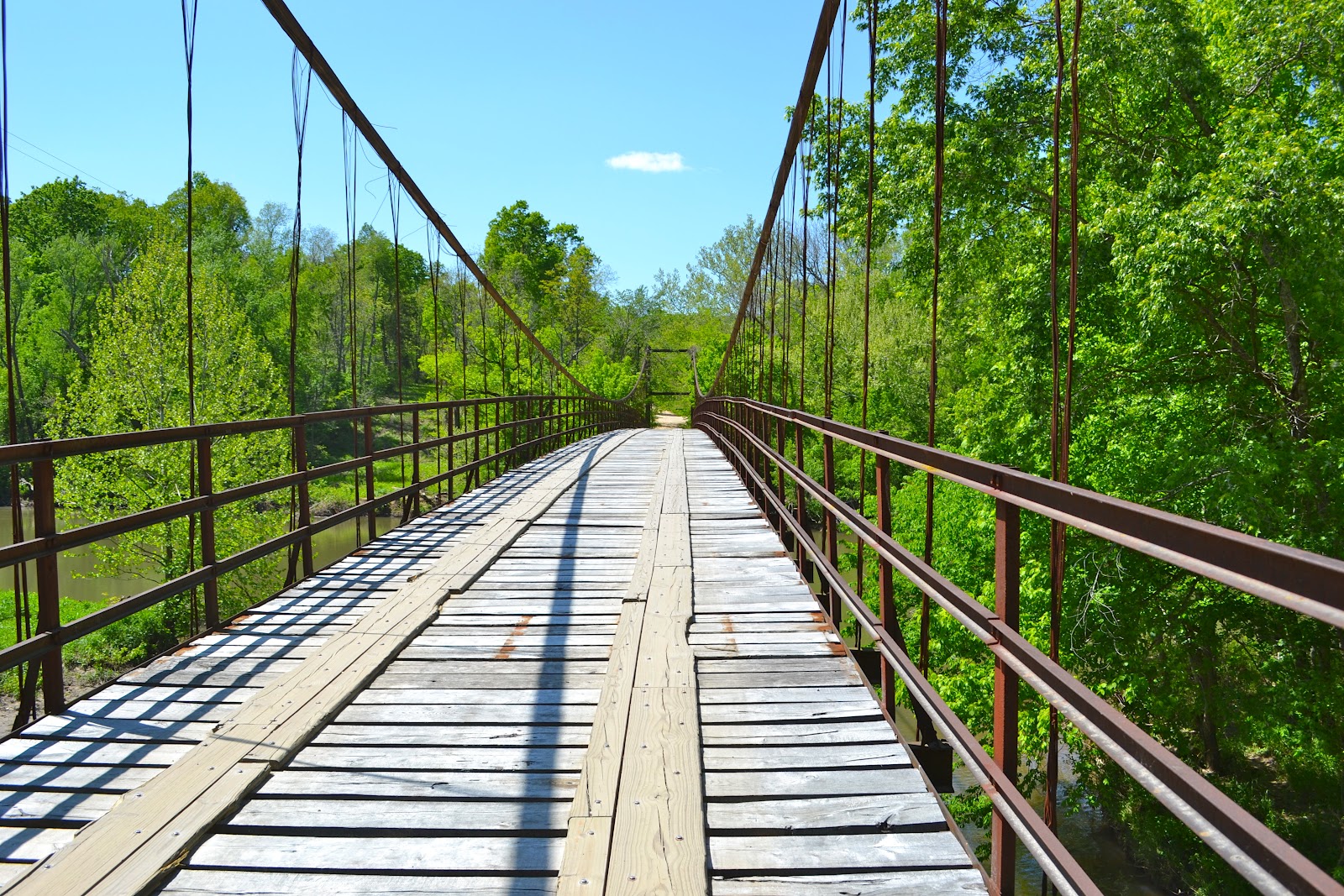
As we made our way down the road, I wasn't really sure what to expect. I had friends who had traveled the road once before - in the dark of night - and the bridge which they told me about could not be the tiny rambler I had just crossed, could it? As I came to a fork in the road which told me Swinging Bridges abruptly turned to the West, I soon realized THIS was the bridge of which I had heard stories - the 500 foot, Grand Auglaize Swinging Bridge.

(View of the Grand Auglaize Swinging Bridge, looking Wast from the towers)

(The sub-structure of the 414' span, looking West across the Grand Auglaize Creek)

(The view from above. My friend who had crossed the bridge in the dark of night had once told me, as they were crossing the bridge she looked at her husband and said: "[Honey], I think were in the tree-tops...". She was correct!)

(The decking was replaced in December 2011. However, the steel trusses and suspension cables are all original; a testament to Mr. Dice, who used to test the tension of the wire by "feel" alone and never used a blueprint in his 45 year career! When the state of Missouri made it a requirement to start providing blueprints for bridges in the 1940's, Joseph A. Dice retired.)

(Sabrina, playing it safe)

Our Wednesday journey to see the "swinging bridges" of Miller County was well worth the trip. To see such a well-preserved piece of architecture functioning much in the same way it did over 80 years ago is quite a marvel. More remarkable is that Mr. Dice and his crew of eleven built the two bridges in the span of four months using only a stump puller and a team of mules to place the large towers, everything else was pure "mean strength." With that in mind, all I can say is - they just don't make 'em like they used to!

References:
Missouri Historical Timeline
Eads Bridge
St. Louis
Lake of the Ozarks
Bagnell Dam
History of Swinging Bridges and Joseph Dice
Grand Auglaize Specs